


If you are shopping for a new-construction home in Florida, especially in fast-growing areas around Tampa Bay, there is a developing story in the homebuilding industry worth understanding.
Lennar, one of the country’s largest homebuilders and a major presence throughout Florida, spun off a company called Millrose Properties in 2025. Millrose was created primarily as a homesite and land-capital platform that Lennar and other builders could use through option arrangements.
More recently, that relationship expanded. In August 2026, Millrose and Lennar amended their Founder’s Rights Agreement to expressly define completed single-family homes acquired by Millrose and intended to be operated as rental properties.
That change has attracted attention following recent reporting that Millrose purchased hundreds of completed Lennar homes around the country, including properties in Florida.
For buyers, the most useful question is not what this means for Lennar’s stock price. It is much more practical: what should you look at before buying in a new-construction community where a builder may also be selling homes to institutional owners?
The Short Version
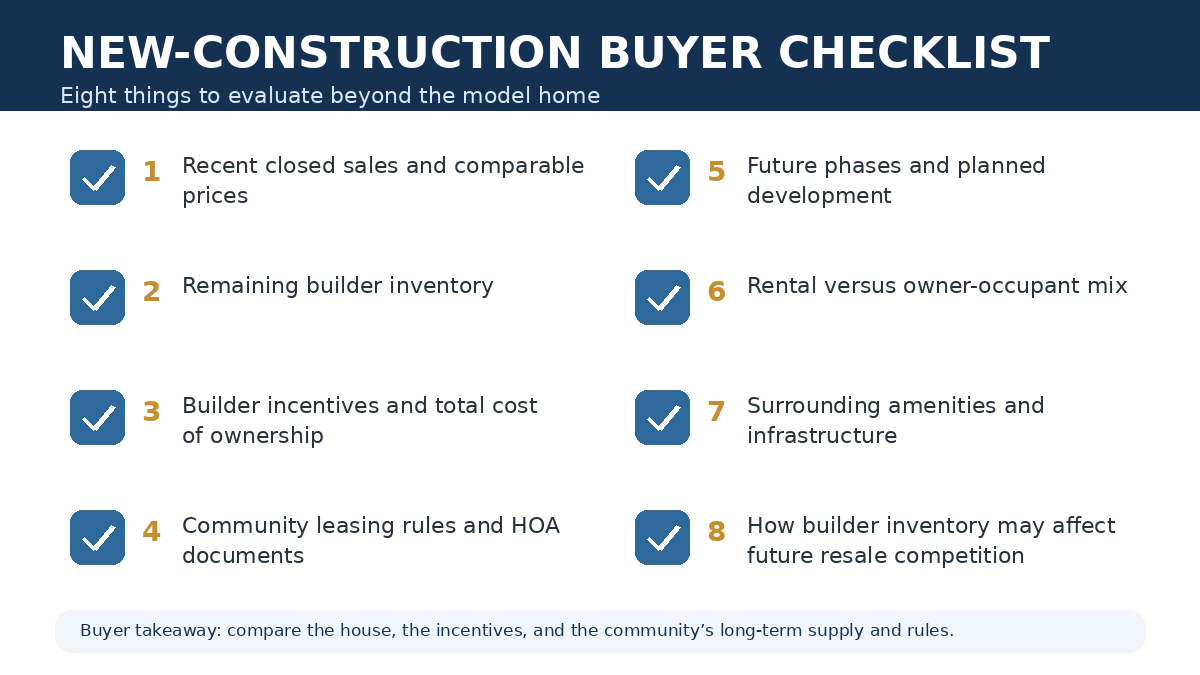
This story does not mean buyers should avoid Lennar communities or new construction. It does mean buyers should look beyond the model home, advertised price, and builder incentive.
- Who is buying homes in the neighborhood.
- How much completed builder inventory remains.
- What comparable homes are actually selling for.
- What incentives the builder is currently offering.
- Whether homes are being purchased for rental use.
- What the HOA or community documents say about leasing.
- How much additional construction is planned.
- How builder inventory could compete with future resale homes.
Those are worthwhile questions in any new-construction community, regardless of the builder.
What Is Millrose Properties?
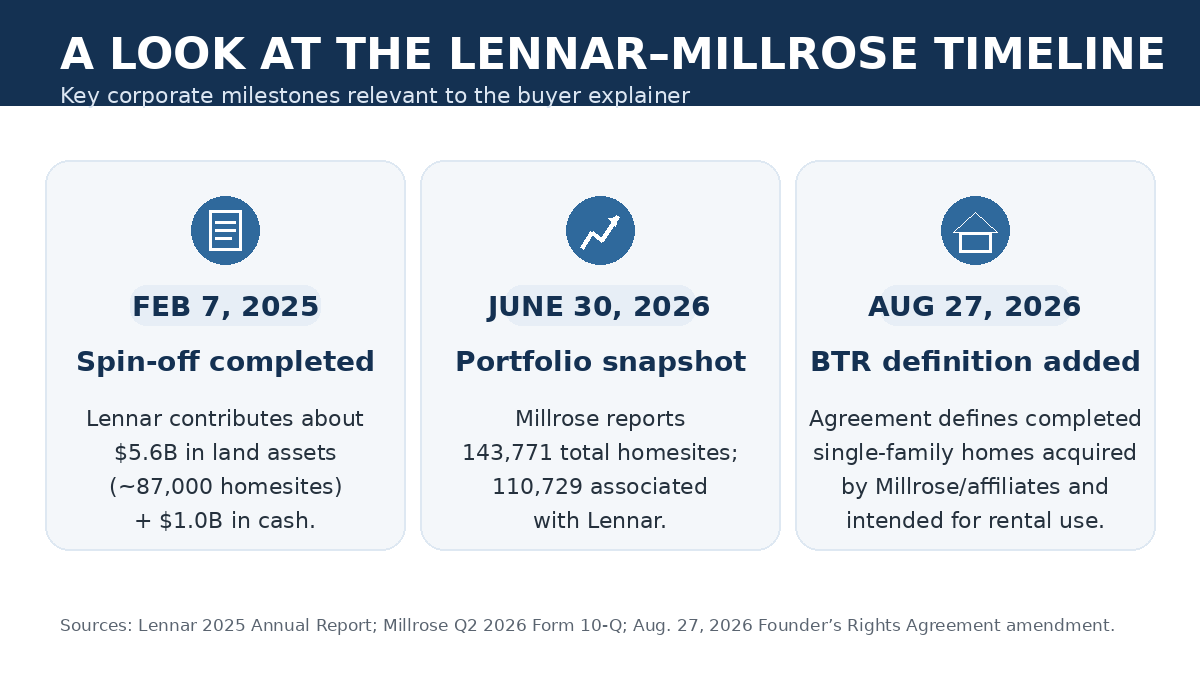
Millrose became an independent publicly traded company in February 2025 when Lennar completed a taxable spin-off of approximately 80% of Millrose’s shares to Lennar shareholders.
In connection with the spin-off, Lennar reported contributing about $5.6 billion in land assets representing approximately 87,000 homesites, plus $1.0 billion in cash. Lennar described the transaction as part of its strategy to become a more asset-light homebuilder.
Instead of carrying as much land directly on its own balance sheet, Lennar can option homesites controlled by Millrose and purchase them as needed for construction.
Lennar later disposed of the approximately 20% block of Millrose shares it had temporarily retained through a November 2025 exchange offer. Its 2025 annual filing states that it retained only an immaterial amount of Millrose shares from employee forfeitures.
That does not mean the business relationship ended. As of June 30, 2026, Millrose reported 143,771 homesites across its property pools. Of those, 110,729 were associated with Lennar.
What Changed in August 2026?
On August 27, 2026, Millrose and Lennar amended their Founder’s Rights Agreement.
The amendment added a defined term, “BTR Properties,” for completed single-family homes acquired by Millrose or its affiliates and intended to be operated as rental properties. It also addressed capital used to fund those acquisitions.
That is important because the contractual structure now expressly contemplates Millrose acquiring completed homes for rental use, rather than limiting the relationship to land and homesites.
For a Florida homebuyer, that does not automatically make a community better or worse. It is simply another part of the ownership and inventory picture that may be worth understanding before buying.
Why Is This Making News Now?
On October 2, investigative outlet Hunterbrook Media published a report stating that it had identified more than 700 completed Lennar homes purchased by Millrose across at least 51 counties in 15 states during roughly a one-month period. Hunterbrook estimated the purchases at approximately $200 million.
Those figures are Hunterbrook’s analysis, not figures reported by Lennar or Millrose in the SEC filings reviewed for this article. Hunterbrook also disclosed that, at the time its report was published, an affiliated investment fund was short both Lennar and Millrose securities. That financial interest is relevant context when evaluating the report.
Update: In an October 8 follow-up, Hunterbrook said its expanded review had identified 1,096 transaction records across 16 states, with an estimated aggregate value of roughly $290 million. Those figures remain Hunterbrook’s analysis and have not been independently established by Lennar or Millrose.
On October 9, 2026, investors filed a federal securities complaint against Millrose Properties and two executives in the U.S. District Court for the Southern District of Florida. The complaint alleges violations of federal securities laws. Those are allegations in pending litigation and have not been adjudicated. Lennar is not named as a defendant in that case.
For a Florida homebuyer, the securities dispute is less important than the real-estate question it raises: what does the ownership, rental, and inventory picture look like inside the community where you are considering buying?

Why This Matters in Tampa Bay
This is not a distant Wall Street story. Lennar currently markets new homes throughout the Tampa / Manatee region, including communities and inventory in Wesley Chapel, Land O’ Lakes, Zephyrhills, New Port Richey, Dade City, Parrish, Palmetto, Riverview, Plant City, and other nearby markets.
At the same time, today’s new-construction market remains highly focused on affordability. In its September 2026 third-quarter results, Lennar reported an average sales price of $372,000 and said that price reflected approximately 12% in incentives, along with base-price adjustments used to sustain volume.
That matters to buyers because the advertised purchase price may tell only part of the story. Builder rate incentives, closing-cost assistance, price reductions, and other concessions can materially affect the economics of a transaction and the competitive environment for future resale owners.
What Should a Buyer Look at Before Purchasing New Construction?
1. Look at recent closed sales
Do not rely only on the builder’s current asking prices. Review what comparable homes have actually closed for recently.
Also understand who the buyer was when a transaction appears unusual. A sale to a large institutional purchaser may have different circumstances than an individual retail home purchase. That does not make the transaction irrelevant, but context matters when evaluating comparable sales.
2. Ask how much builder inventory remains
Find out how many completed homes are available, how many homes are under construction, how many future phases are planned, and approximately how long the builder expects to remain active in the community.
A homeowner who wants to sell a few years from now could still be competing with brand-new inventory, builder incentives, and preferred-lender promotions.
3. Understand current builder incentives
A builder may offer a significant incentive tied to its affiliated mortgage company or a particular property. That can be valuable, but compare the total economics, including purchase price, interest rate, closing costs, HOA fees, CDD or other assessments, property taxes, insurance, upgrades, and potential resale competition.
The biggest advertised incentive is not automatically the best overall deal.
4. Review the community’s leasing rules
If the balance between owner-occupied and rental homes matters to you, read the actual HOA or community documents rather than relying on assumptions about whether rentals are allowed.
Ask about minimum lease terms, waiting periods before leasing, rental caps if any, approval procedures, and whether different sections of the community have different restrictions.
5. Understand what is being built around you
A beautiful model home tells you what the house can look like. It does not tell you everything about the completed neighborhood.
Look at the site plan and ask about future phases, townhomes versus detached homes, apartment or rental components, commercial development, road connections, planned amenities, and undeveloped parcels nearby.
Does Institutional Ownership Automatically Hurt Home Values?
No. There is not enough information to make a blanket statement that institutional ownership or rental ownership automatically reduces property values.
Home values are influenced by many factors, including location, supply and demand, condition, interest rates, insurance costs, taxes and assessments, school zones, amenities, builder inventory, comparable sales, and the broader housing market.
Some buyers prefer communities with a high percentage of owner occupants. Others may not consider the rental mix particularly important. The relevant point is transparency: a buyer should understand the community’s ownership patterns, rules, and future supply before making a major financial decision.
New Construction Can Still Be a Great Option
New construction can offer new systems and finishes, builder warranties, energy-efficient construction, lower immediate maintenance needs, current design features, and financing incentives that may not be available on resale homes.
The mistake is assuming that buying new means there is less homework to do. In many cases, there is simply different homework.
My Perspective as a Greater Tampa Bay Real Estate Professional
When I work with buyers considering new construction, I want them looking beyond the model-home experience.
The home itself matters, of course. But so do the surrounding sales, remaining inventory, incentives, HOA restrictions, planned development, and long-term competition within the neighborhood.
The recent Lennar-Millrose story is a good reminder of why that broader view matters. It does not mean a Lennar home is a bad purchase. It means buyers should understand the market they are buying into, particularly in rapidly growing communities where builders, individual homeowners, and institutional buyers may all be active at the same time.
A strong purchase decision is based on more than the builder’s brochure. It is based on information.
Thinking About New Construction in Greater Tampa Bay?
If you are considering a new-construction home in Wesley Chapel, Land O’ Lakes, Pasco County, or elsewhere in Greater Tampa Bay, having your own real estate representation can help you compare builder inventory, incentives, resale competition, and recent comparable sales before you make a decision.
If you would like help evaluating a community or comparing new construction with resale options, contact Kristen Bubis to discuss your goals and the current market.
Editor’s note: Information in this article is current as of October 15, 2026. Corporate agreements, litigation, inventory, pricing, and builder incentives can change.
This article was prepared with AI-assisted research and drafting tools and reviewed for accuracy by Kristen Bubis, a licensed Florida real estate professional.
Sources
SEC filings and company sources
- Lennar Corporation, 2025 Annual Report on Form 10-K (fiscal year ended November 30, 2025).
- Lennar Corporation, press release on the completed Millrose spin-off (February 7, 2025).
- Millrose Properties, Inc., Form 10-Q for the quarter ended June 30, 2026.
- Millrose Properties, Inc., Amendment to Founder’s Rights Agreement (dated August 27, 2026; SEC exhibit).
- Lennar Corporation, third-quarter 2026 results (September 16, 2026).
- Lennar, Tampa / Manatee new-home communities, viewed October 2026.
Court records
- Rubenstein et al. v. Millrose Properties, Inc. et al., U.S. District Court for the Southern District of Florida, docket (complaint filed October 9, 2026). Allegations in pending litigation have not been adjudicated.
Reporting
- Hunterbrook Media, report on Millrose purchases of completed Lennar homes (October 2, 2026). Figures cited above are Hunterbrook’s analysis. Hunterbrook disclosed that an affiliated fund was short Lennar and Millrose securities when the report was published.
- Hunterbrook Media, “The Story Millrose Told Investors Doesn’t Match the Evidence” (October 8, 2026), follow-up reporting the expanded 1,096-record / 16-state / roughly $290 million figures. Those figures are Hunterbrook’s analysis; the follow-up carries the same short-position disclosure.
Disclosure: This article is provided for general real estate information and educational purposes only. It is not investment, legal, tax, or financial advice. Kristen Bubis is not affiliated with or sponsored by Lennar Corporation or Millrose Properties, Inc. References to investigative reporting and pending litigation are attributed to their respective sources; allegations in pending litigation have not been adjudicated. Kristen Bubis, who publishes this site, is a licensed Florida real estate sales associate with eXp Realty, LLC (License #SL3643035).
Questions about this article?
Kristen M. Bubis, REALTOR® · eXp Realty, LLC · License #SL3643035
Contact Kristen