

On a model-home countertop in Wesley Chapel sits a price sheet for a $500,000 house.
Consider two prospective buyers studying that same sheet. One has lived in Florida for years and wants a larger home. The other plans to retire from New Jersey and move south in 2027.
They could select the same floor plan, pay the same price and close within weeks of each other. Their mortgage payments might be nearly identical.
Their future property taxes could tell a different story.
The difference has little to do with the house. It comes down to where each buyer permanently lived on December 31, 2026.
That date now carries unusual financial weight.
On November 3, 2026, Florida voters approved Amendment 3, formally CS/HJR 1-F, with approximately 62 percent of the vote. The constitutional amendment, which takes effect January 1, 2027, substantially increases the homestead exemption for non-school property taxes.
But it does not extend the larger benefit immediately to everyone buying a Florida home.
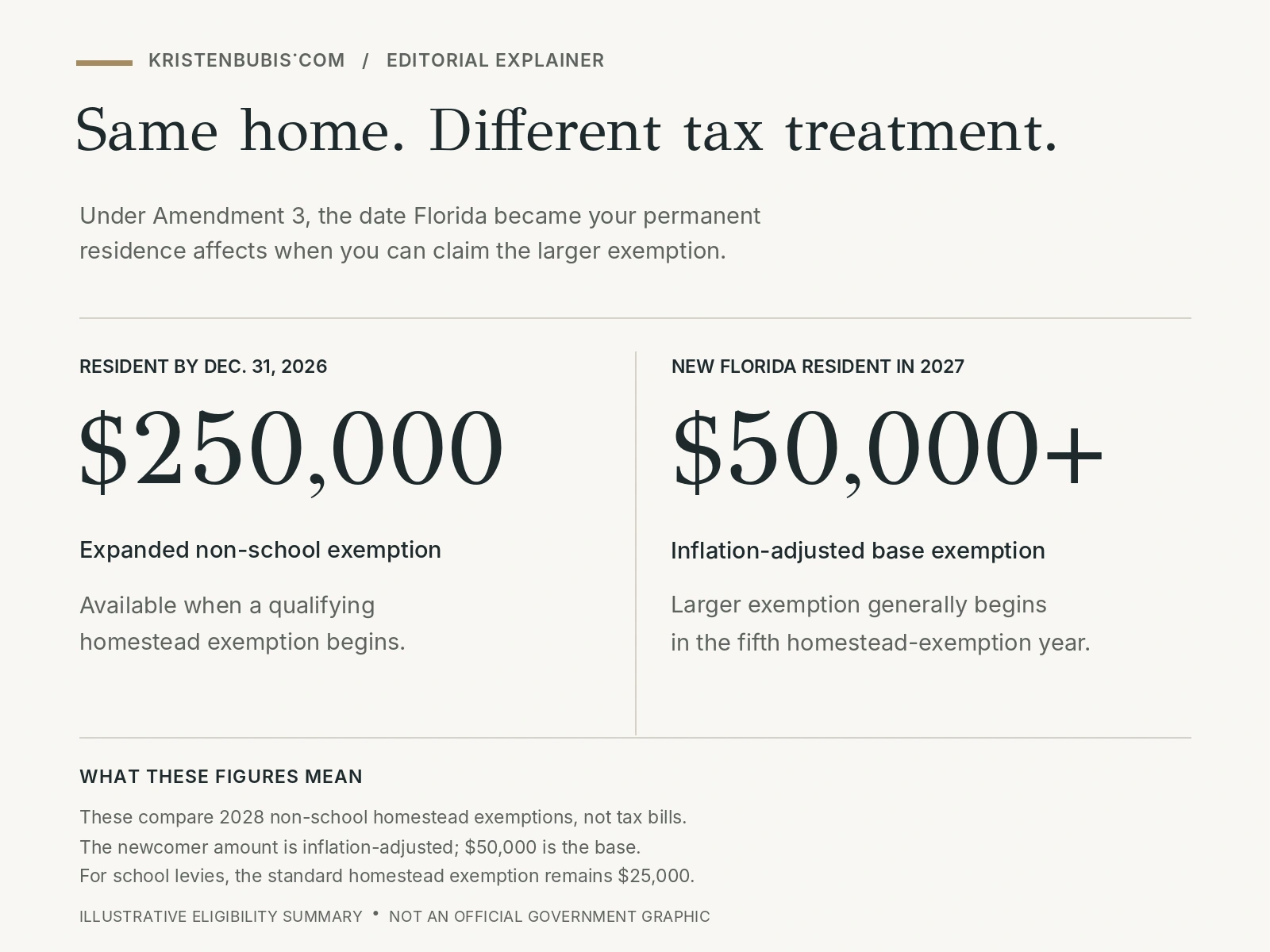
Instead, it establishes a dividing line: People who maintained permanent Florida residency by December 31, 2026, can generally qualify for the expanded exemption when they establish a homestead. Those who establish permanent residency afterward initially receive a smaller exemption and, under the amendment, must ordinarily wait until their fifth year of receiving a homestead exemption to obtain the larger benefit.
For buyers entering Florida’s new-construction market in 2027, that distinction could affect years of housing costs.
The New Homestead Exemption Has Two Starting Points
Florida’s homestead exemption reduces the assessed value of a qualifying primary residence before certain property taxes are calculated. It does not reduce the home’s market value or mortgage balance.
The distinction matters because Florida divides property taxes among school district levies and other taxing authorities, including counties, municipalities and certain special districts.
Under Amendment 3, qualifying homeowners who satisfied the December 31, 2026 residency requirement receive a substantially larger exemption from non-school property taxes:
- 2027: Up to $150,000 of assessed value is exempt.
- 2028: The exemption increases to $250,000.
- 2029 and beyond: The $250,000 amount is adjusted annually for positive inflation growth.
School district property taxes remain separate. The standard homestead exemption for school levies remains $25,000 of assessed value.
For someone who first establishes permanent Florida residency on or after January 1, 2027, the starting point is different.
That homeowner initially qualifies for a non-school exemption of up to $50,000, provided the property meets ordinary homestead requirements. The $50,000 amount becomes subject to positive inflation adjustments beginning in 2028.
The larger exemption generally becomes available in the fifth year of receiving the homestead exemption, not simply after five years of living in Florida.
The distinction is consequential. A buyer who moves to Florida in 2027, purchases a home that year and first receives homestead exemption for 2028 would ordinarily reach the fifth exemption year in 2032, assuming uninterrupted qualification and no applicable change in the law.
Amendment 3 also provides for possible local reductions of the waiting period beginning in 2030 under specified conditions. The Legislature must establish uniform procedures for implementation.
For now, the larger benefit should not be treated as automatic for newly arriving residents.
What the Difference Could Mean on a $500,000 Home
Consider the two buyers in Wesley Chapel.
Both purchase completed homes during 2027. Assume each property has an assessed value of $500,000 when it first qualifies for homestead exemption in 2028.
The longtime Florida resident meets the December 31, 2026 cutoff. The New Jersey retiree establishes Florida residency after that date.
For an illustration, assume non-school taxing authorities collectively levy 10 mills and school authorities levy 5 mills.
A mill represents $1 in property tax for every $1,000 of taxable value. A 10-mill rate therefore produces $1,000 in tax on each $100,000 of taxable value before exemptions or other adjustments.
The 2028 exemption is $250,000 for the established Florida resident. For the newcomer, assume a hypothetical 2 percent inflation adjustment increases the $50,000 non-school exemption to $51,000.
Under those assumptions, the calculation looks like this:
| Item | Established Florida resident | New Florida resident |
|---|---|---|
| Assessed property value | $500,000 | $500,000 |
| Non-school homestead exemption | $250,000 | $51,000 |
| Taxable value for non-school levies | $250,000 | $449,000 |
| Non-school tax at 10 mills | $2,500 | $4,490 |
| School tax at 5 mills, after $25,000 exemption | $2,375 | $2,375 |
| Total illustrative annual ad valorem tax | $4,875 | $6,865 |
The difference: $1,990 a year, or approximately $166 a month.
That is not a forecast for any particular Tampa Bay property. The example assumes equal assessed values, no Save Our Homes portability, no additional exemptions and hypothetical millage and inflation rates. It excludes non-ad valorem assessments, including many CDD charges.
Actual 2028 millage rates, assessment values, inflation adjustments and property-specific exemptions are not yet known.
Still, the comparison illustrates the financial distinction Amendment 3 creates. Even when two houses carry identical assessed values, their owners may have different taxable values because of when they established Florida residency.
The gap can persist for several tax years.
And for buyers stretching their budgets to afford a newly built home, the difference between an advertised monthly payment and the eventual cost of ownership deserves careful attention.
Why New-Construction Buyers Face Another Tax Risk
There is a second issue that has nothing to do with Amendment 3.
A newly built house can carry a surprisingly low property tax bill before its full value appears on the county tax roll.
Florida property appraisers determine property values based on the property’s condition as of January 1. If a house was not substantially complete for assessment purposes on that date, the tax roll may reflect only the land rather than the finished residence.
Consider a home completed and sold in September 2027.
Its 2027 property taxes could be based largely on the value of the lot as it existed on January 1, before construction was completed. When the property is assessed as a finished home for 2028, its taxable value could rise sharply.
A buyer reviewing the earlier tax bill might mistake an unusually low assessment for an ongoing expense.
The problem is not limited to new construction. When a property changes ownership, previous exemptions and accumulated assessment protections generally do not transfer automatically to the purchaser. The property is ordinarily reassessed at just value, or market value, subject to applicable exceptions such as portability.
The purchase price may help inform that valuation, but it does not mechanically determine the property appraiser’s assessed value.
For buyers, this means the number printed on a builder’s cost sheet may be a poor representation of the taxes they will ultimately pay.
A lender’s initial escrow calculation can also rely on an earlier tax amount. When the completed home’s higher assessment appears, the lender may adjust the escrow payment to reflect the new obligation and any shortage.
The monthly housing payment can increase even when the mortgage’s principal and interest remain unchanged.
Before signing a new-construction contract, buyers should ask whether the projected property tax reflects vacant land, a partially completed home or the estimated assessed value of the finished property under their own exemption eligibility.
Those are different calculations.
Buying in 2027 Does Not Mean Receiving a 2027 Homestead Exemption
The timing of the purchase introduces another complication.
Florida generally requires a homeowner to own the property and occupy it as a permanent residence on January 1 of the tax year for which a homestead exemption is claimed.
The standard filing deadline is March 1.
A buyer closing in June 2027 and moving into the house that summer would generally first be eligible for that property’s homestead exemption for the 2028 tax year, provided all requirements are met and the application is timely filed.
That homeowner would not ordinarily receive a new 2027 homestead exemption simply because the purchase closed before the end of 2027.
For the two hypothetical Wesley Chapel buyers, the meaningful comparison therefore begins with the first tax year in which their new homes qualify, rather than the calendar year in which they sign their contracts.
A prospective buyer should distinguish three dates: the date Florida became the person’s permanent residence, the date the property was purchased and occupied, and the January 1 assessment date on which homestead eligibility is evaluated.
Amendment 3 makes all three worth understanding.
What If You Move to Florida Before December 31, 2026, but Rent First?
This is one of the amendment’s more important provisions for people planning a relocation.
The December 31, 2026 cutoff concerns permanent Florida residency. It does not necessarily require someone to own a Florida home by that date.
Someone who genuinely establishes Florida as a permanent residence before the cutoff while living in a rental property could generally qualify for the larger exemption after purchasing and establishing a qualifying homestead, even if the purchase occurs in 2027 or later.
That offers a different path from buying immediately.
A retiree, for example, might move into a Florida rental in December 2026, establish permanent residency and spend the following year exploring new-construction communities.
If the residency was legally established by the cutoff and the later property qualifies, the person may be eligible for the expanded exemption without the five-year waiting period.
By contrast, someone who first moves to Florida and rents in 2027 would generally not begin accumulating years toward the amendment’s waiting period merely by renting. The constitutional language measures that period by years of receiving a homestead exemption.
The difference is subtle but significant.
It is also an area where forthcoming administrative guidance will matter, particularly regarding how counties verify residency established before the deadline.
A Florida Driver’s License Is Evidence, Not a Shortcut
The financial incentive to establish residency before December 31 may lead some prospective buyers to accelerate their relocation plans.
But buying property, signing a lease or obtaining a Florida driver’s license does not, by itself, conclusively establish permanent residency.
Florida law treats permanent residency as a factual determination.
Under Florida Statutes §196.015, a county property appraiser may consider evidence including a declaration of domicile, voter registration, driver’s license, vehicle registration, employment location, federal income tax records, the location of bank accounts and the termination of residency in another state.
No single factor is necessarily decisive.
Someone who continues to live and work primarily in another state while maintaining a Florida address may face a different determination from someone who actually relocates and makes Florida the center of daily life.
And the consequences of changing domicile can extend beyond Florida property taxes.
A New York resident, for example, may be subject to that state’s rules governing part-year residency, statutory residency, income earned within New York and the evidence required to establish a change of domicile. Moving to Florida does not automatically eliminate all tax obligations to the former state.
For retirees with investment income, people selling businesses, and households with homes or employment in multiple states, the timing of a move can affect income tax reporting and estate-planning decisions.
An anticipated Florida property tax benefit should be evaluated alongside those obligations.
The appropriate move is a genuine relocation supported by consistent facts and documentation, not a hurried change of mailing address.
Current Florida Homeowners May Have an Additional Advantage
For a current Florida homeowner upgrading to new construction, the expanded exemption may be only part of the financial picture.
Florida’s longstanding Save Our Homes provision limits annual increases in the assessed value of qualifying homestead property to the lesser of 3 percent or the applicable Consumer Price Index change.
Over time, that can create a meaningful difference between a home’s market value and its assessed value.
Florida’s portability rules allow eligible homeowners to transfer up to $500,000 of accumulated Save Our Homes assessment benefit to a new qualifying Florida homestead, subject to the statutory requirements and calculation.
That benefit is separate from the homestead exemption itself.
For instance, someone selling a long-owned house in Pinellas County and purchasing a newly built property in Pasco County may qualify to transfer some accumulated assessment savings to the new property.
A buyer arriving from another state generally would not have an existing Florida Save Our Homes benefit to transfer.
As a result, the longtime Florida homeowner may benefit from both a lower assessed value through portability and a larger non-school homestead exemption under Amendment 3.
Portability is not automatic. Eligible homeowners must apply, generally using Form DR-501T with their new homestead application, and comply with the applicable deadlines.
The benefit depends on the former property’s assessment history and the relative market values of the old and new homes.
What About Second Homes and Investment Properties?
Amendment 3 also changes the rules for properties that do not qualify as a primary residence.
Beginning in 2027, the annual assessment increase cap for qualifying non-homestead properties falls from 10 percent to 5 percent for non-school property taxes.
That includes certain second homes, rental properties and other qualifying real estate.
But the cap applies to increases in assessed value, not directly to the total tax bill. It does not control school district levies, freeze millage rates or necessarily prevent reassessment when ownership changes or qualifying improvements are made.
A vacation home does not become eligible for the expanded homestead exemption merely because its owner spends part of the year in Florida.
For a retiree considering both a northern residence and a Florida home, the distinction between a permanent homestead and a second home remains central.
What Amendment 3 Does Not Reduce
A larger homestead exemption does not mean every expense associated with a new home will fall.
School district levies still apply under their separate exemption rules. Homeowners insurance premiums, HOA dues, utilities and maintenance costs remain independent of the expanded homestead exemption.
Community Development District assessments require particular attention in many Greater Tampa Bay new-construction developments.
CDD charges often appear on the same annual property tax bill as ordinary property taxes, but many are collected as non-ad valorem assessments rather than taxes based on a property’s taxable value.
Those assessments are generally not reduced by the new homestead exemption.
A buyer could therefore receive substantial non-school property tax relief while still owing significant CDD assessments.
For a more detailed explanation, see CDD vs. HOA Fees in Pasco County: What Florida Homebuyers Should Check Before Buying.
The distinction matters most when buyers compare communities with different combinations of property taxes, district assessments, association fees and builder incentives.
What Buyers Should Verify Before Signing a Contract
For anyone planning to purchase a Florida home in 2027, the central question is no longer simply what the property taxes are today.
It is what the property taxes are likely to become after the house is completed, ownership changes and the buyer’s individual exemptions are determined.
Buyers should request a property-specific tax estimate using an appropriate finished-home valuation. They should ask which school and non-school millage rates have been used, whether non-ad valorem assessments are included, and whether the calculation assumes an exemption for which they actually qualify.
Current Florida homeowners should investigate Save Our Homes portability. Out-of-state buyers should clarify their residency history and eligibility for the expanded exemption with the appropriate county property appraiser.
Anyone considering establishing Florida residency before December 31, 2026 should consult qualified legal and tax advisers, particularly if the move involves another state’s income tax rules.
Florida lawmakers are expected to address implementation details, and the Department of Revenue has indicated that additional rules, forms and guidance will follow. The residency distinction may also be subject to federal constitutional limits and future legal developments.
Until those questions are resolved, buyers should treat preliminary estimates as estimates.
A builder can explain construction timelines, available incentives and purchase prices. A county property appraiser determines assessed values and exemption eligibility. A qualified tax professional can assess how a change of residency may affect the buyer beyond Florida.
Those responsibilities should not be confused.
The Same House, a Different Financial Future
Return to the two buyers considering the $500,000 model home in Wesley Chapel.
Both may love the floor plan. Both may qualify for the same builder incentives. Both may sign nearly identical purchase contracts.
But the longtime Florida resident enters the transaction with a different tax history from the person moving from New Jersey in 2027.
One may qualify for the expanded homestead exemption as soon as the new property becomes eligible. The other may have to wait several years.
Neither buyer can determine the full cost of the house from the builder’s price sheet alone.
A model home can show buyers exactly what they are purchasing. It cannot show them what their residency history will mean for the property tax bill.
In 2027, understanding that difference may be as important as negotiating the price.
Exploring New-Construction Homes in Greater Tampa Bay?
Whether you are relocating to Florida, retiring, purchasing your first home or moving into a newly built property, understanding the total cost of ownership is an important part of comparing communities.
I help buyers explore new-construction homes throughout the Greater Tampa Bay Area and surrounding counties, including Pasco, Hillsborough and Pinellas Counties.
I can help you compare properties, organize builder and community information, and identify the tax and assessment questions worth resolving before you commit. For property tax eligibility, legal residency questions and individual financial decisions, the appropriate county officials and licensed advisers should provide the final guidance.
Contact Kristen to discuss your home search.
Kristen M. Bubis, REALTOR®
eXp Realty, LLC | Florida Real Estate Sales Associate
Florida Real Estate License #SL3643035
Greater Tampa Bay Area and Surrounding Counties
KristenBubis.com
Sources and Further Reading
Amendment 3
- Florida Legislature, Enrolled CS/HJR 1-F (2026).
- Florida Department of Revenue, Informational Bulletin PTO 26-21 (November 5, 2026).
- Florida Senate, Summary of 2026 Special Session Amendment.
Residency, exemptions and portability
- Florida Statutes §196.015: Permanent Residency Determinations.
- Florida Department of Revenue, Property Taxpayer Information.
- Florida Department of Revenue, Save Our Homes and Portability FAQ.
- New York State, Residency and Nonresident Income Tax FAQ.
Editor's note: Information verified against Florida Department of Revenue and Florida Senate sources on November 12, 2026. Amendment 3 takes effect January 1, 2027; additional guidance may change administrative procedures or affect individual eligibility. Numerical comparisons are illustrative, not forecasts.
Disclosure: This article provides general real estate information, not legal, tax, accounting, lending or investment advice. Homestead eligibility and assessed values are determined by the appropriate county property appraiser. Verify rates, assessments and individual circumstances with qualified professionals. Kristen Bubis is a Florida real estate sales associate affiliated with eXp Realty, LLC.